GEO-16
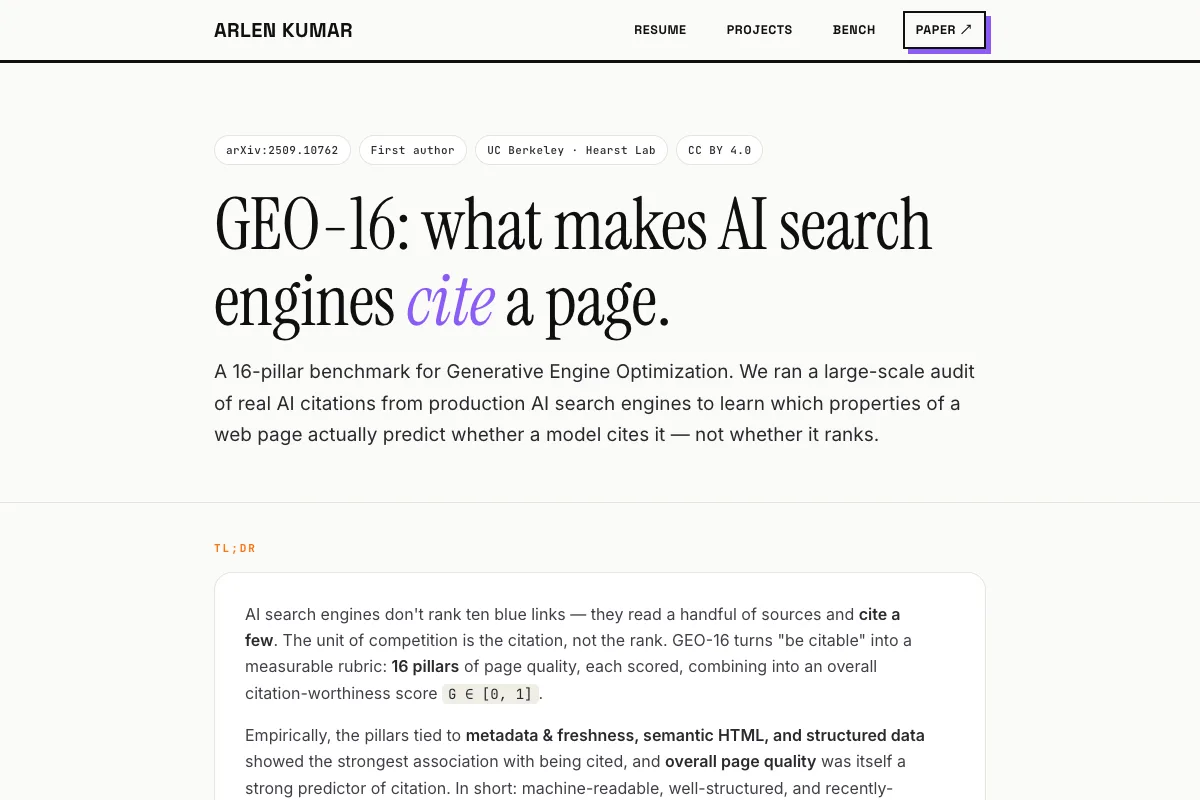
A 16-factor framework for what AI answer engines actually cite — grounded in an empirical audit of real citations across production engines, not vibes.
CTO @ Wrodium · NLP/IR @ Berkeley Hearst Lab · GEO-16
CTO at Wrodium. NLP/IR researcher at Berkeley's Hearst Lab. Currently building the knowledge-freshness infrastructure that decides what AI engines cite — and writing autopsies for dead benchmarks.
Berkeley · SkyDeck · Hearst Lab
The honest version. Three things, each with a real deadline.
CHASE @ COLM 2026
Research paper submitted to COLM 2026 — the Conference on Language Modeling. Awaiting the decision round.
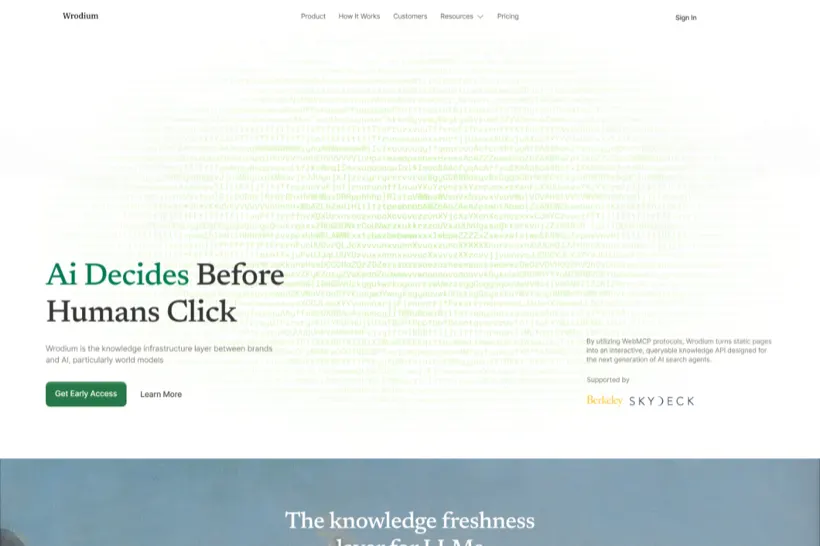
Wrodium
Building the GEO + knowledge-freshness infrastructure that decides which sources AI engines trust and cite.
Every card links to something live.
A 16-factor framework for what AI answer engines actually cite — grounded in an empirical audit of real citations across production engines, not vibes.
Autopsies of dead AI benchmarks — saturation, contamination, gaming — as a citable dataset with reproducible saturation curves and evidence tiers.
Competitive Lean 4 theorem proving — a full Glicko-2 rating engine, a sandboxed warm prover pool, and an authoritative match server.
An honest fishing forecast on real NOAA data with a public, auto-published accuracy scoreboard — it ships the Brier score even when it's embarrassing.
Describe a content workflow in plain English; the Copilot builds the agent pipeline — ground, generate, de-slop, publish.
Loads an interactive app from wrodium-dashboard-ui.vercel.app — nothing third-party loads until you click.
Live demo · the Workflow Copilot composing a daily-blog → CMS pipeline from one prompt
Hallucinations aren't just embarrassing — they're expensive. I build systems that give LLMs perfect context: structured, verified, current.
Most American business content is a mess — outdated pages, unstructured data, no fact-verification layer. Wrodium is the infrastructure layer that makes AI accurate about real businesses. The goal isn't just to be cited — it's to be cited correctly.


At 19 I built and sold Air Quake Simulations, a VR flight-sim hardware company whose 3D-printed cockpits undercut the industry roughly 10×.
Today I research how AI answer engines decide which sources to cite at UC Berkeley's Hearst Lab under Prof. Marti Hearst — the work that became the GEO-16 framework.
And I'm CTO of Wrodium, building the infrastructure that decides who gets cited when AI becomes the interface to everything.
Leanid and I started it because the companies that structure their content for AI today will own their categories tomorrow. Everyone else will wonder where their traffic went.
We show you exactly how AI systems currently describe your brand. (Spoiler: it's probably wrong or incomplete.)
We restructure your content so AI engines can parse, verify, and cite it — schema markup, semantic structure, fact-verification layers.
AI changes fast. We keep your content current so you don't drift into hallucination territory.
We track AI visibility and citations so you can tie "ChatGPT mentioned us" to actual revenue.
We've built integrations for six major CMS platforms. We run experiments constantly. We know what works because we test it — not because we read a blog post about prompt engineering.
Leanid and I ran hundreds of experiments on how AI answer engines select sources. The result: "AI Answer Engine Citation Behavior: An Empirical Analysis of the GEO-16 Framework" — a paper identifying the 16 factors that predict whether AI cites you.
It's not theoretical. It's built from real queries, real responses, and real citation patterns across ChatGPT, Gemini, Perplexity, and Claude.
I treat research as product development: every insight becomes a feature, every experiment becomes something I can ship.
Read GEO-16 on arXiv →
The web has a credit problem — creators of accurate, useful content get erased when AI summarizes them with no link. Better structure, better standards, better tracking for how AI cites sources.
I've studied how AI systems erase or misrepresent people — that's a product concern, not just an ethical one. I build systems that optimize for accurate exposure, not just exposure.
I like research. I like shipping more. The best part of Wrodium is turning abstract ideas like "generative engine optimization" into dashboards, workflows, and reports people actually use.

A VR flight-simulator hardware company. Built affordable 3D-printed cockpit components that undercut the industry by 10×.
Read the story →Co-founded with Leanid Palkhouski. Berkeley SkyDeck-backed. Building the GEO platform for AI-era discovery.
Studying AI citation behavior under Prof. Marti Hearst. Developed the GEO-16 predictive framework.

A community network for Silicon Valley dog owners. Shut down during COVID. (Yes, really.)
Read the story →
Leanid Palkhouski, Co-founder @ Wrodium
San Francisco · December 15, 2025
I like comparing notes with people making real systems — researchers, founders, and anyone fighting bureaucracy with code.
Let's talk →